



Qlik Data Integration combines Qlik Replicate (formerly Attunity) with Talend-heritage tooling, now converging on Qlik Talend Cloud. Striim is a unified real-time platform built for cloud scale, in-pipeline AI, and continuous innovation.
vs
Multi-node distributed in-memory cluster with automatic failover — vs. Qlik’s single-node engine that relies on external OS-level Active-Passive clustering.
In-flight joins, enrichment, filtering, and windowed aggregation before data lands — vs. Qlik’s ELT model that transforms after landing.
Real-time vector embeddings and LLM-ready pipelines built into the CDC platform — vs. Qlik, whose AI sits at the analytics layer, not the pipeline.
Striim advantagE
Purpose-built OJET (Oracle) and MSJET (SQL Server) adapters engineered by the GoldenGate founders, with configurable exactly-once (E1P) delivery on supported targets.
Striim advantagE
In-flight, high-performance transformations with masking, filtering, enrichment, and aggregations on in-memory compute.
Limited pre-defined transforms; transformation becomes a pipeline bottleneck.
Striim advantagE
One integrated platform for CDC, streaming transformations, delivery, and monitoring with unified SLAs.
Requires integrating Replicate (CDC) + Talend (ELT) + Qlik Catalog (quality) + Enterprise Manager as separate tools.
Striim advantagE
Validata reconciles source and target record-by-record with six validation methods, auto-generates repair SQL, and re-verifies — built for CDC assurance, migration cutover, and audit evidence.
No equivalent in Replicate or Qlik Talend Cloud; customers build their own row-count / checksum comparisons outside the product.
Striim advantagE
Writes directly via Snowflake Streaming API and BigQuery Storage Write API with no file staging.
Stages data as CSV / external files, then loads with repeated COPY commands, driving up warehouse ingress cost.
Striim advantagE
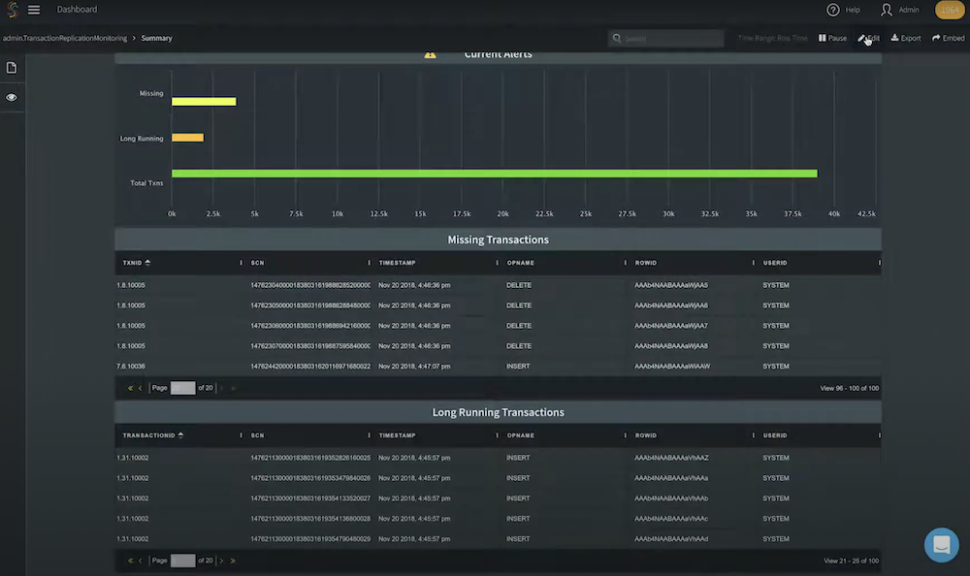
Real-time dashboards match source-to-target transactions, validate delivery, and alert on missing or long-running transactions.
Minimal replication task stats; no real-time match validation or SLA tracking.
Striim advantagE
AI-driven PII discovery (Sherlock AI) and in-line detection + masking (Sentinel AI) across 25+ data types, plus OAuth, SSO, and customer-managed encryption keys.
Manual, column-by-column masking (SHA-256 hash / obfuscation); no AI-based sensitive-data detection.
Striim advantagE
Foreseer flags anomalies on the live stream and Euclid generates vector embeddings in-flight for real-time RAG and agentic use cases.
AI capabilities live at the analytics layer (Discovery Agent) or as a batch pipeline step, not in the CDC pipeline.
Fortune 500 companies power their cloud initiatives with Striim
“Real-time data visibility across disparate systems reduced duplicate patient records by 40% and improved clinical outcomes through faster care coordination.”
Director of Data Integration
“Striim's sub-2-second latency enabled real-time fraud detection, reducing false positives by 35% and preventing $2.1M in annual losses.”
Chief Data Officer
“Streaming clinical trial data to Databricks in real-time accelerated study timelines by 6 months and improved data quality through continuous validation.”
VP of Data & Analytics
|
|
|
|
|---|---|---|
|
Architecture |
|
Single-process engine per task with no native clustering; HA requires customer-built external OS clustering (Veritas, Red Hat Cluster Suite, IBM HACMP) plus shared block storage. |
|
Unified platform |
One integrated platform for CDC, streaming transformations, delivery, and monitoring with unified SLAs and single vendor support. |
Multi-tool stack: Replicate (CDC) + Talend (ELT) + Qlik Catalog (quality) + Enterprise Manager; separate APIs, learning curves, support tickets. |
|
Real-time transformations |
In-flight, high-performance SQL with masking, enrichment, filtering, and aggregations.
|
Limited pre-defined transforms; transformation becomes a bottleneck.
|
|
Latency
|
End-to-end latency under 2 seconds with built-in SLA enforcement and real-time match validation.
|
Lacks end-to-end latency guarantees; difficult to monitor and troubleshoot lag.
|
|
Cloud-native & SaaS
|
Fully managed SaaS engine on Google Cloud, Azure, AWS, and Snowflake; the Forwarding Agent is optional and outbound-only for private connectivity.
|
SaaS control plane, but the Data Movement gateway is mandatory for Oracle, SAP, and Db2 sources regardless of network topology.
|
|
Security & governance
|
AI-driven PII discovery and in-line masking (Sherlock AI + Sentinel AI), OAuth, SSO, customer-managed encryption keys.
|
Manual, rule-based masking; no AI-based sensitive-data detection.
|
|
AI/ML enablement
|
In-pipeline anomaly detection (Foreseer) and in-flight vector embeddings (Euclid) for AI-ready, LLM-connected pipelines.
|
AI capabilities sit at the analytics layer or as batch steps, not inside the CDC pipeline.
|
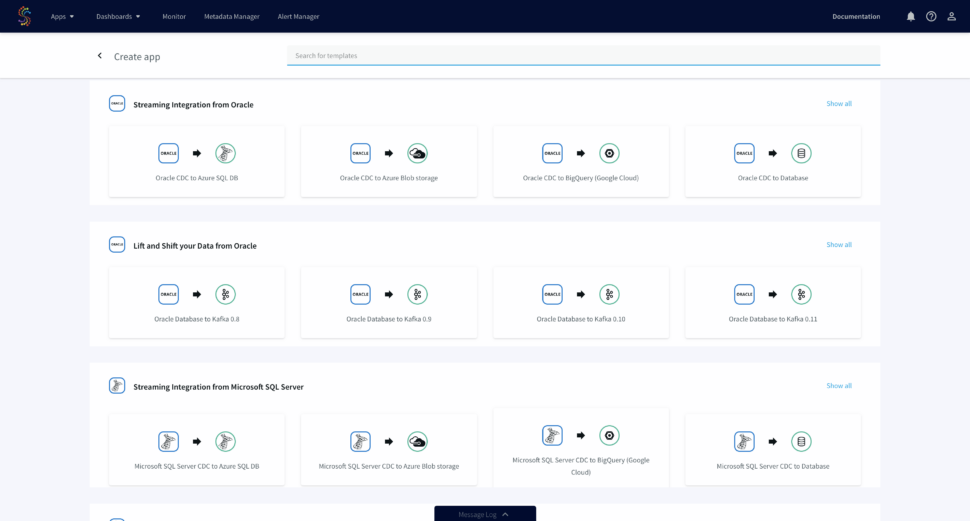
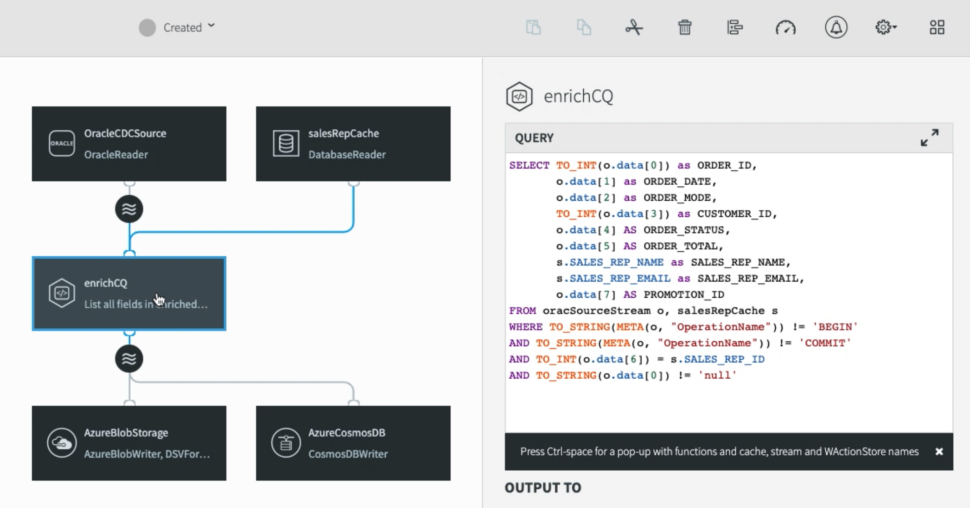
Select from hundreds of templates to simplify building your data flows. A step-by-step wizard will lead you through the process of connecting to your source and target to create a data flow application. You can also create custom data flows from scratch.
Your data flow defines how to collect, process, and deliver data. The simplest data flow just has a source, a stream, and a target. In many cases you will need to perform some processing on your data. Striim enables you to set up continuous SQL queries optimized for streaming, real-time data.
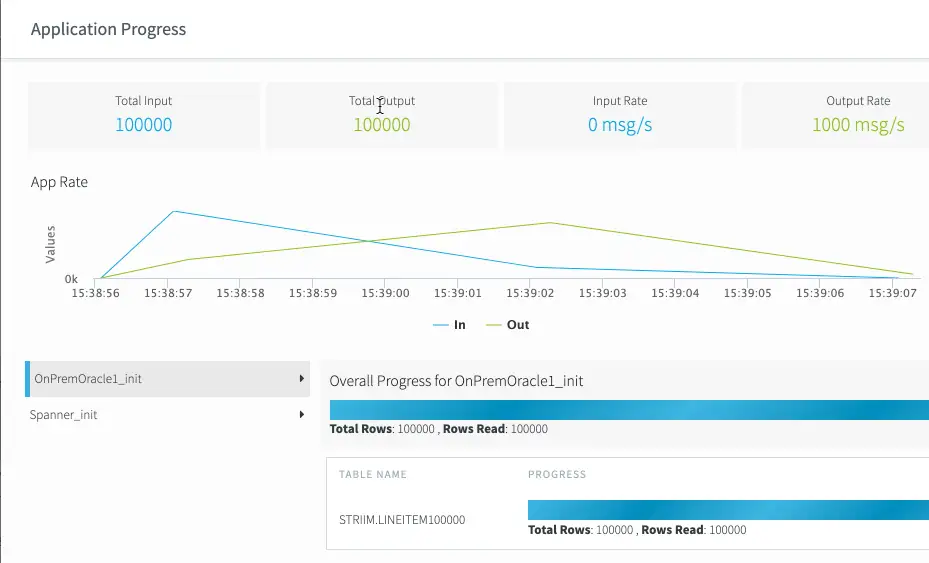
Our built-in dashboards and monitoring enable you to see the state of your data flows in real-time and easily identify any bottlenecks. Striim can also validate that your data has been delivered and provide visibility into the end-to-end lag. This level of visibility is essential for mission-critical systems that may have SLAs regarding how current the data is.
You can also drill down on any of the components in a data flow to see detailed statistics that include read/write rate, lag, latency, CPU usage, and many other metrics. This detailed information can help identify any bottlenecks, and aids in tuning data flows for maximum performance and minimal latency.
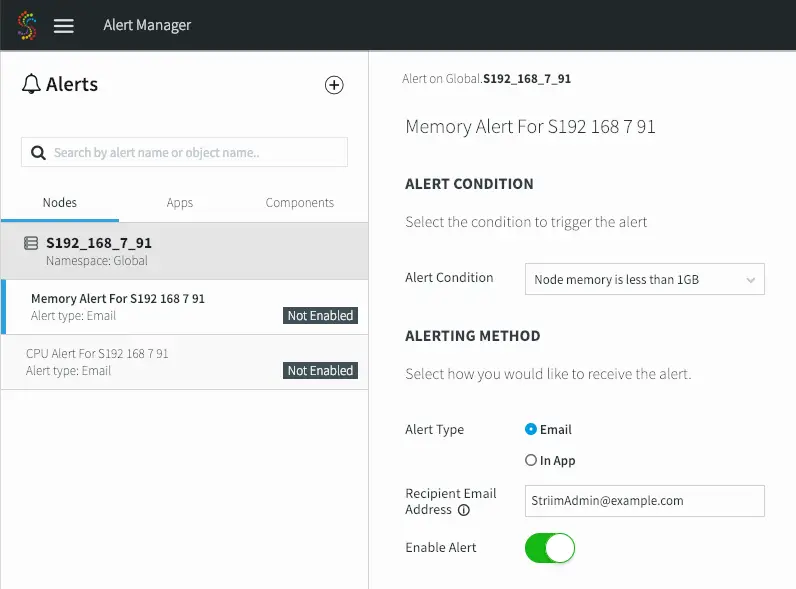
Striim allows you to define SQL-based custom alerts so you can stay informed about the status and performance of your data flows.
In the case of errors, or failures, you can also automate workflows to perform corrective actions. By tapping into error or status streams you can trigger compensating data flows to start, or perform other actions to remediate problems.
“At UPS, we’re reshaping the shipping landscape by prioritizing lower premiums and improved convenience for our customers. Opting for high-confidence shipping addresses not only slashes costs but also assures customers of dependable and secure deliveries, empowering them to shop online with confidence and ease. Striim and Google Cloud have jointly enabled us to enhance the customer experience with AI and ML.”
“Striim is a fully managed service that reduces our total cost of ownership while providing a simple drag and drop UI. There’s no maintenance overhead for American Airlines to maintain the infrastructure.”
“Striim gives us a single source of truth across domains and speeds our time to market delivering a cohesive experience across different systems.”
“One of the most notable benefits we’ve experienced since integrating Striim into our operations has been the significant enhancement in how we communicate with our customers. The real-time updates on order status have not only improved transparency but also helped to reduce the number of customer service calls. This change has streamlined our operations, allowing us to allocate resources more efficiently and improve overall customer satisfaction.”
“The choice to use Snowflake was part of our platform’s evolution. We needed Striim to complete the vision.”
“We have a significant software portfolio and the ability to tie that into modern ML use cases where we need to do that is important for us. We are a highly data-driven organization and the ability to tie in predictive models or propensity models is really critical to our strategy. The objective with Striim and CDC usage was to simplify pipelines and minimize latency for real-time decision support.”
We've prepared a few articles to help you get started.
Yes. Qlik acquired Attunity in 2019 and folded it into Qlik Data Integration alongside Talend and the former Podium (now Qlik Catalog). The underlying replication engine is the former Attunity product.
Striim is a unified real-time platform for CDC, transformations, delivery, and monitoring with unified SLAs and single-vendor support. Qlik requires integrating Replicate (replication), Talend (ELT), Qlik Catalog (quality), and Enterprise Manager (monitoring) as separate tools with different APIs, learning curves, and vendor relationships.
Striim runs a multi-node, Active-Active distributed cluster with automatic failover and scales out and up in a single click. Qlik Replicate runs a single process per task with no native clustering — high availability requires customer-built external OS clustering (Veritas, Red Hat Cluster Suite, IBM HACMP) plus shared block storage.
Striim performs in-flight joins, enrichment, filtering, and windowed aggregation on data before it lands. Qlik’s primary Data Integration designer is ELT — it transforms after the data has already been written to the target.
Striim writes directly via the Snowflake Streaming API and BigQuery Storage Write API with no file staging. Qlik stages CSV / external files and loads with repeated COPY commands, which drives up warehouse ingress cost.
No. Striim Validata reconciles source and target record-by-record, generates repair SQL, and re-verifies after remediation. Qlik has no documented equivalent in Replicate or Qlik Talend Cloud — customers build their own row-count and checksum checks outside the product.
Yes. Striim generates real-time vector embeddings (Euclid), detects anomalies on the live stream (Foreseer), and integrates with LLMs — all inside the pipeline. Qlik’s comparable AI capabilities live at the analytics layer or run as batch steps, not in the CDC pipeline.