If there’s one thing to ask yourself when reviewing your data architecture this year, it should be this: what happens if the pace of my data can’t keep up with my business? The lag between when an event occurs and when your systems can act on it is the hidden cost of delayed data.
That same gap surfaces across every line of business: personalization engines recommending products customers have already bought, predictive maintenance models receiving sensor readings after equipment has failed, and inventory systems committing stock that no longer exists. For data and technology leaders, the stakes have shifted. The primary consumer of enterprise data is no longer an analyst reviewing a dashboard. It’s a model making decisions at scale, often with no human in the loop.
An analyst can recognize stale data and adjust. A model can’t: it acts on whatever it receives, with the same confidence, whether that data is two seconds old or two days old. That makes data freshness a question of AI readiness and enterprise risk, not just pipeline engineering. This guide covers what real-time data ingestion is, how it compares to batch, how the architecture works, and what it takes to implement it at enterprise scale.
Key Takeaways
- Define “real time” by business outcome. Fraud prevention demands sub-second latency, while operational reporting can tolerate a few seconds. Setting freshness targets by use case keeps infrastructure spend aligned with business value.
- Architect ingestion around your systems of record. Use log-based Change Data Capture (CDC) for production databases, event streaming for data already in motion, and batch where latency carries no business cost.
- Real-time data ingestion is a prerequisite for enterprise AI. Models are only as current as the data that feeds them, and continuous, fresh data is what moves AI from pilot to production.
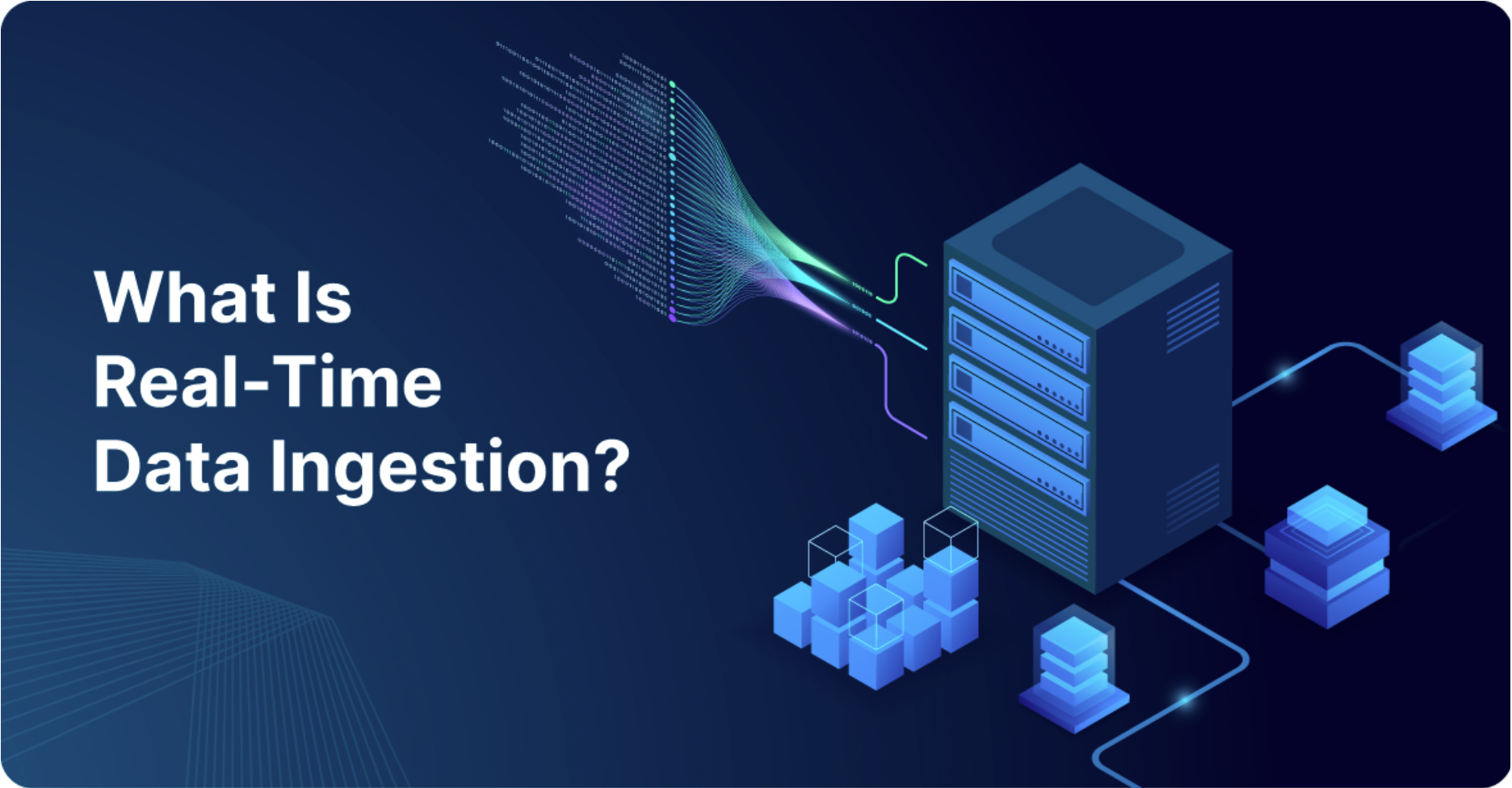
Real-time data ingestion is the continuous process of capturing data the moment it’s created and making it instantly available to downstream systems, such as analytics platforms, operational applications, and AI models. There are no scheduled windows and no batch jobs. Each new transaction, event, or sensor reading moves as it happens.
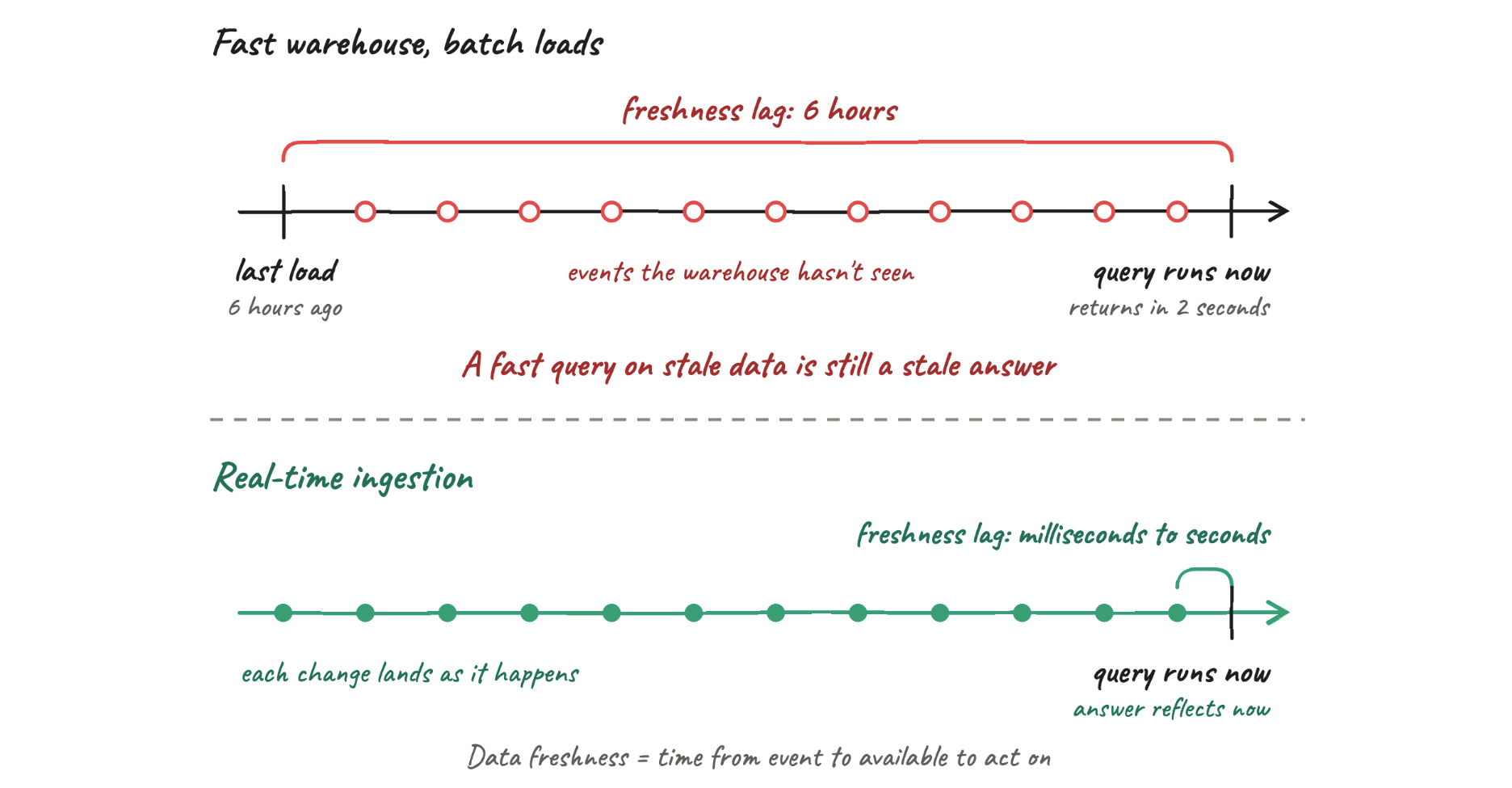
Think of it as the difference between a ledger reconciled at the end of the day and a live account balance. Both are accurate. Only one tells you what’s true right now. Enterprise real-time ingestion pipelines share three defining characteristics:
- Low latency. Data becomes queryable within milliseconds to seconds of being generated, not hours later.
- Continuous flow. Pipelines run always-on, processing events as they arrive rather than waiting for a scheduled run.
- Diverse, high-velocity sources. A single pipeline captures data from transactional databases, application logs, IoT sensors, message queues, and APIs at the same time, often at thousands of events per second.
At Striim, we often talk about how the metric that separates real-time ingestion from everything else is data freshness: the time between when an event occurs and when it’s available to act on. That’s distinct from query performance. Many enterprises have invested heavily in cloud data warehouses that return results in seconds, but if the data underneath was loaded six hours ago, a fast query on stale data is still a stale answer. For AI workloads, freshness is the binding constraint. A fraud model, a pricing engine, or an AI agent can only make decisions as current as its inputs. Measuring freshness, not just throughput or query speed, is how data leaders know whether their infrastructure can support real-time decisions in production.
Real-Time vs. Batch Data Ingestion
Batch ingestion collects data over a set period, then loads it into a target system in a single scheduled job, typically hourly, nightly, or weekly.
It’s been the backbone of enterprise data warehousing for decades, and for good reason. Batch is efficient at scale, simple to operate, and well suited to many workloads where completeness matters more than timeliness, such as payroll runs, regulatory filings, and quarter-end reconciliation.
But for certain use cases, the trade-off of batch-based ingestion becomes clear. Every batch window is like taking a photograph: a windowed period in which your systems are blind to what’s happening elsewhere in the business. For historical reporting, that’s acceptable. For decisions that need to happen while a customer is still on the site, a transaction is still pending, or a machine is still running, it isn’t.
Real-time ingestion removes the windowed view. Instead of moving data in large, periodic blocks, it moves each change as it happens, keeping downstream systems continuously in sync with the source.
That shift is especially critical for AI systems. Models fed by nightly batches are always reasoning about yesterday, while models fed by streaming pipelines are reasoning about now. Engineering teams at enterprises like Uber have documented their own move from batch to streaming for exactly this reason: to accelerate data freshness across their data lake.
| Feature | Real-Time Ingestion (Streaming) | Batch Ingestion |
|---|---|---|
| Data arrival | Continuous, event by event as it happens. | In large, scheduled groups (blocks). |
| Latency | Milliseconds to seconds. | Hours, days, or weeks. |
| System impact | Low, steady, and predictable resource usage. | High, concentrated spikes in compute. |
| Primary metric | Data freshness (immediate relevance). | Data volume (efficiency at scale). |
| When to use | When immediate action or live tracking is required (e.g., fraud alerts, live IoT monitoring, ride-share matching). | When historical depth or massive scale matters more than speed (e.g., payroll processing, nightly BI reports, end-of-quarter audits). |
Most enterprises won’t, and shouldn’t, choose one model exclusively. The practical question is which workloads lose value with every hour of delay. Those are the ones to move to real time first.
Real-time data ingestion has moved from an architectural preference to a competitive requirement. Enterprises running on delayed data are making decisions about a world that no longer exists, and the cost of that gap is measurable. Card fraud is the clearest real-world example. While a fraudulent transaction executes in seconds, batched ingestion cycles can only surface it hours later. Every loss in that interval is one your systems could have prevented, had the data arrived in time to flag it. The same pattern plays out across industries and business units.
Financial Services
In financial services, the window between fraud execution and fraud detection is where losses accumulate, and batch ingestion is what holds that window open. When transaction data reaches your risk systems hours after authorization, your fraud models can only confirm what has already happened. Streaming each authorization into scoring models as it occurs lets you block a suspicious payment before it clears, rather than flag it the next morning. See how Striim supports financial services.
Retail and E-Commerce
Retail shows how a single real-time pipeline can serve two very different consumers at once. On the operational side, inventory systems need live stock positions across stores, warehouses, and channels. Without them, you oversell items that are already gone and miss orders you could have filled. On the AI side, personalization engines need to know what a customer browsed and bought minutes ago, not last night. The same stream of order and clickstream events feeds both. Explore Striim for retail and CPG.
Manufacturing and IoT
A predictive maintenance model is only as useful as the freshness of the sensor data feeding it. If vibration, temperature, and pressure readings arrive in hourly batches, the model may spot the warning signs of a failure after the failure has occurred. Batch delivery quietly turns a predictive system into a reactive one. Real-time ingestion gives the model the lead time it was built to provide: enough warning to schedule maintenance before a production line goes down. Learn more about Striim for manufacturing and energy.
Logistics and Transportation
In logistics, the value of location and status data decays by the minute. A gate change, a delayed inbound flight, or a reshuffled cargo sequence demands an immediate response from ground crews, planners, and the systems that coordinate them. Thirty-minute-old position data has no operational value when a container needs rerouting now. See how Striim supports travel, transportation, and logistics.
The Common Thread: AI Runs on Fresh Data
In every one of these examples, the real-time pipeline feeds more than a dashboard. It feeds an AI model or an automated decision system: a fraud score, a product recommendation, a maintenance alert, a routing decision. At Striim, we see the same pattern across enterprise AI programs. A model performs well in testing, then underdelivers in production because the data infrastructure beneath it can’t keep pace. AI investments rarely fail loudly. They fail quietly, on stale inputs. Real-time data ingestion is what makes a model usable in production, not just in a demo, which is why the mechanics of how it works deserve a closer look.
How Real-Time Data Ingestion Works
Every real-time data ingestion pipeline, regardless of vendor, moves data through five stages. Breaking the pipeline down this way makes it easier to pinpoint where latency creeps in and where failures are most likely to occur.
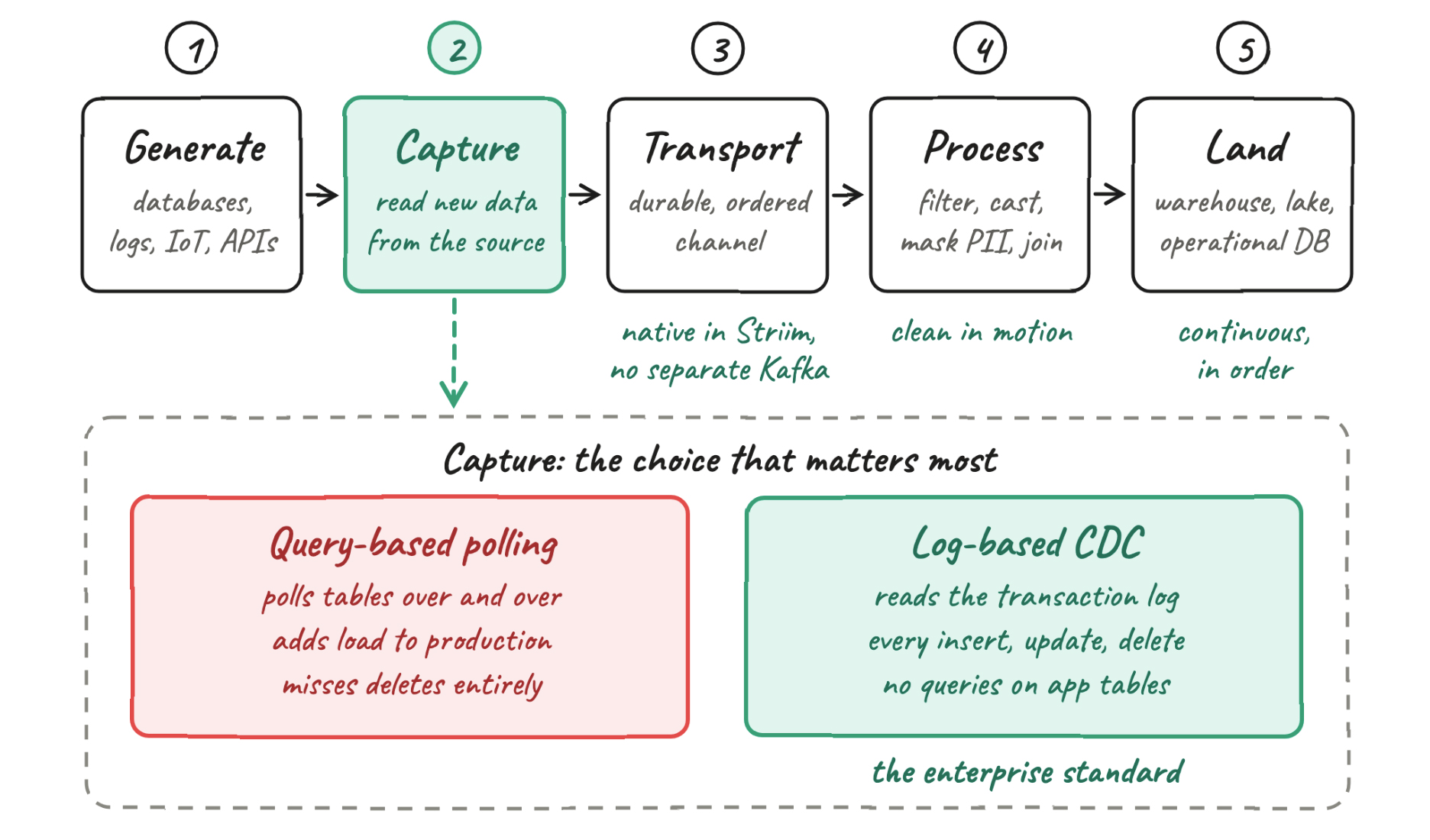
- Event and data generation. Data originates in your operational systems: relational databases such as Oracle, SQL Server, PostgreSQL, and MySQL, along with application logs, IoT sensors, message queues, and SaaS APIs. Each source behaves differently. A production database generating thousands of row-level changes per second is a very different ingestion problem from a REST API firing occasional webhooks, and your architecture needs to account for both.
- Capture. This is where the pipeline reads new data from the source, and for databases, the method matters more than any other decision you’ll make. Query-based extraction repeatedly polls tables for changes, adding load to production systems and missing deletes entirely. Log-based Change Data Capture (CDC) reads the database’s own transaction or redo log instead, capturing every insert, update, and delete as it’s committed, without querying the tables your applications depend on. For enterprise workloads, log-based CDC is the standard.
- Transport. Captured events need a durable, ordered channel to move through. Apache Kafka is the most widely used option, alongside cloud equivalents such as Amazon Kinesis, Google Cloud Pub/Sub, and Azure Event Hubs. Many enterprises end up running and tuning a Kafka cluster purely to move data from point A to point B. Striim handles this layer natively, so your team doesn’t need to stand up and manage Kafka independently unless you choose to.
- In-flight processing. Before data lands, it can be filtered, enriched, and reshaped while it’s still in motion. Common steps include filtering out irrelevant records, casting data types to match the target schema, masking personally identifiable information (PII), and joining events with reference data. Transforming data in transit means your targets receive clean, analysis-ready records rather than raw output that has to be cleaned up downstream.
- Landing. Finally, the pipeline writes data to its destination: a cloud data warehouse such as Snowflake, BigQuery, or Databricks, a data lake, an operational database, or a streaming analytics platform. The best pipelines write continuously and in order, so the target always reflects the current state of the source.
Each stage is a potential bottleneck. A pipeline with sub-second capture but a transformation layer that batches records every five minutes isn’t real time, it’s just batch with extra steps. End-to-end freshness is only as good as the slowest stage of the data lifecycle.
Real-Time Data Ingestion Methods and Approaches
There’s no single right way to ingest data in real time. The right method depends on where your data lives, how fast it changes, and what the target needs to receive. Use the guide below to match each method to the workloads it serves best.
Change Data Capture (CDC)
Log-based CDC captures changes directly from a database’s transaction log: Oracle redo logs, SQL Server transaction logs, MySQL binlogs, and PostgreSQL write-ahead logs. Because it reads the log rather than querying tables, it records every insert, update, and delete in commit order, with no additional load on the production database. That combination is what makes CDC the gold standard of enterprise real-time ingestion. Your systems of record, the ERP, core banking, order management, and patient record databases that run the business, are also the hardest sources to tap without disrupting them. CDC lets you stream from those systems continuously while the applications that depend on them run untouched. It also preserves the full history of change, not just the latest state, which matters for auditability and for any model that learns from how data evolves over time. CDC is also where Striim’s engineering is concentrated. Striim reads directly from source transaction and redo logs to deliver inserts, updates, and deletes with sub-second latency, and pairs an initial bulk load with continuous CDC so targets stay in sync from day one without a cutover gap. Best for: Streaming changes from mission-critical operational databases to cloud data warehouses, data lakes, and AI systems without impacting production performance.
Event Streaming Pipelines
Some data is already in motion. If your applications publish events to Apache Kafka, Amazon Kinesis, Google Cloud Pub/Sub, or Azure Event Hubs, the ingestion task is to consume those streams and route them reliably to the right targets, often with filtering or enrichment along the way. Best for: Enterprises with existing event-driven architectures that need to move streaming data into analytics platforms or downstream applications.
Real-Time ETL
Real-time ETL applies transformations while data is in transit, so the target receives clean, structured, analysis-ready records rather than raw change events. That can mean filtering noise, masking sensitive fields, standardizing formats, aggregating over time windows, or joining a stream with reference data. Striim’s Streaming SQL lets your teams define these transformations in familiar SQL syntax, rather than writing and maintaining custom stream-processing code. Best for: Pipelines where data needs to be cleansed, enriched, or governed before it lands, especially when feeding AI models or regulated environments.
API and Webhook-Based Ingestion
For SaaS applications and third-party sources with no direct database access, APIs and webhooks provide a path in. The application pushes an event, or your pipeline polls an endpoint, whenever something changes. This approach is typically near-real-time rather than sub-second: latency depends on the provider’s delivery guarantees and rate limits. Best for: Capturing events from SaaS platforms, partner systems, and external services where a database connection isn’t available.
Combining Methods
The best enterprise architectures use several of these methods at once: CDC for core databases, event streaming for application events, real-time ETL to shape data in flight, and APIs to fill the gaps. Running each on a separate platform multiplies the operational burden. Striim supports all four within a single platform, with 100+ prebuilt connectors spanning databases, messaging systems, cloud services, and data warehouses.
Real-Time Data Ingestion for AI and ML Readiness
Many machine learning models that underperform in production don’t have a modeling problem. They have a data delivery problem. A model that scored well offline starts making weaker predictions once deployed, and the root cause sits upstream, in a pipeline that can’t deliver data as fast as the model needs it. If your team is evaluating whether your current infrastructure can support production AI, these are the three failure modes to look for first.
Stale Feature Stores
A feature store holds the computed inputs a model uses to make predictions: a customer’s transaction count over the last hour, a device’s average temperature over the last 10 minutes, or a shopper’s most recent product views. When those features refresh in batch, they describe a past state. A fraud model checking “transactions in the last hour” against a feature updated six hours ago is evaluating the wrong hour. The model logic is sound. Its inputs aren’t.
Training/Serving Skew
Training/serving skew occurs when the data a model sees in production differs from the data it was trained on. Batch pipelines are a common cause. If features were computed from complete, settled historical data during training but are served from partial or delayed data in production, the model is operating on a different distribution than the one it learned. Predictions degrade, often so subtly that no one notices until something breaks or a key business metric is impacted.
Delayed Feedback Loops
Models improve by learning from outcomes: whether a flagged transaction was actually fraudulent, whether a recommended product was purchased, whether a predicted equipment failure occurred. When outcome data arrives in daily or weekly batches, the loop between prediction and correction stretches out. Drift goes undetected for longer, retraining happens on outdated signals, and the model falls further behind the behavior it’s meant to predict.
How Data Freshness Affects Each Stage of the ML Lifecycle
| Stage | What freshness determines | What happens when data is stale |
|---|---|---|
| Training data pipelines | How closely training data reflects current behavior, patterns, and edge cases. | Models learn outdated patterns and miss emerging ones, such as new fraud tactics. |
| Feature serving | Whether the features used at prediction time reflect the present state of the customer, device, or account. | Predictions are based on who the customer was, not who they are now. |
| Inference inputs | Whether the event being scored arrives with its latest context. | Personalization recommends products already purchased, and fraud scoring misses fast-moving attacks. |
| Post-deployment monitoring | How quickly you detect drift, degraded accuracy, or data quality issues. | Problems surface in business metrics days or weeks after they begin. |
Before you take a model into production, ask three questions of the pipeline behind it:
- How old is the oldest feature the model uses at inference time?
- Are training features and serving features handled by the same pipeline, from the same sources?
- How long does it take for an outcome to flow back into monitoring and retraining?
The pattern holds across real-time personalization, fraud scoring, and predictive maintenance alike. Each depends on models acting on the current state of the world. Real-time data ingestion isn’t a data engineering preference layered on top of an AI strategy. It’s part of the AI infrastructure itself, and it deserves the same treatment and consideration as the models it feeds.
Migrating from Batch to Real-Time: What Actually Changes
Moving from batch to real-time ingestion isn’t just a case of swapping a nightly scheduler for streaming. This new ingestion approach changes how your pipelines are built, how they’re monitored, what your team needs to know, and how you pay for infrastructure. Enterprises that plan for those shifts upfront migrate faster and with far fewer surprises.
| Area | Batch | Real-Time |
|---|---|---|
| Pipeline architecture | Scheduled jobs that extract, transform, and load in discrete runs. | Always-on pipelines that capture, process, and deliver each change continuously. |
| Monitoring | Did the job succeed or fail? | Is data flowing, how far behind is it, and is it correct right now? |
| Team skills | SQL, orchestration, and job scheduling. | Event-driven design, ordering and delivery guarantees, and stream processing. |
| Cost model | Large compute spikes during batch windows, idle capacity in between. | Steady-state throughput, with capacity sized for sustained volume and bursts. |
The monitoring shift catches many teams off guard. A batch job either finishes or it doesn’t. A streaming pipeline can be running (technically healthy) and still falling behind or delivering malformed records. Your operational model needs to account for that from day one.
Start With the Pipelines That Lose Value Fastest
One thing we stress to our clients is that not everything needs to move to real time, and not all at once. Prioritize the pipelines where delay has a direct business cost: fraud detection, inventory availability, customer-facing personalization, operational monitoring, and any data feeding a production AI model. These are the latency-sensitive, high-value workloads where real-time ingestion pays back quickly. Workloads like monthly financial close, historical trend analysis, and compliance archiving can stay in batch for now, and some should stay there permanently. The goal isn’t to eliminate batch. It’s to stop using batch for decisions that can’t wait.
Plan for the Hybrid Period
For most enterprises, batch and streaming will run side by side for months, sometimes longer. That transition period comes with its own challenges:
- Dual maintenance. Your team supports two pipeline paradigms, two sets of failure modes, and two operational runbooks at the same time.
- Data consistency across both paths. When the same source feeds both a batch and a streaming pipeline, the two targets can disagree. Define which path is authoritative for each use case, and reconcile them regularly.
- Cutover risk. Switching a downstream consumer from batch to streaming requires validating that the new pipeline delivers complete, correct data before you retire the old one.
Treat the hybrid period as a deliberate phase with clear exit criteria, not an indefinite state.
How Fast Can a Migration Happen?
Faster than many enterprises expect. American Airlines’ TechOps team built a real-time data hub that streams maintenance and operational data from MongoDB into Microsoft Azure and Databricks, giving teams live visibility into aircraft and operations worldwide. The team reached production at global scale within 12 weeks. With the right platform and a clear set of priority use cases, real-time ingestion is a quarter-long initiative, not a multiyear program.
Of course, a real-time pipeline that works in a proof of concept can still fail in production. The difference usually comes down to six considerations that are easy to underestimate early and expensive to fix later. Getting them right is what separates a smooth implementation from months of firefighting.
Source System Impact
The fastest way to lose the support of your database administrators is to slow down a production system. Query-based extraction does exactly that. Repeated polling generates heavy read loads, competes for locks with the transactions your applications depend on, and adds latency to the systems that run the business. The more frequently you poll to reduce delay, the worse the impact becomes. Log-based CDC avoids that trade-off. Instead of querying tables, it reads the change records the database already writes for its own recovery: Oracle redo logs, SQL Server transaction logs, and MySQL binlogs. It captures each change at sub-second latency without touching the database’s execution engine, so production performance stays where it is. Log-based CDC also helps when it comes to preventing schema drift. When an upstream team adds a column or changes a data type, those structural changes appear in the log alongside the data. A mature CDC pipeline detects them automatically and propagates them to the target data warehouse, rather than breaking the pipeline and waiting for an engineer to intervene.
Volume and Scalability
On a typical day, pipelines rarely fail without a spike in volume or some other outside influence. They tend to fail at the worst moments: Black Friday, a market open, a month-end close, or a sensor fleet coming back online after an outage. Plan for burst capacity, not just average throughput. A pipeline sized for steady-state volume will fall behind the moment traffic spikes, and in real-time systems, falling behind compounds quickly. A mature architecture handles bursts in two ways. It scales horizontally, adding processing nodes as load increases. And it applies backpressure, buffering data safely when a downstream target slows down temporarily, instead of dropping records or crashing. Scale also changes the design itself. An architecture that comfortably handles thousands of events per second is fundamentally different from one built for millions. At high throughput, partition key design is critical. Routing related events, such as every change to the same customer account, to the same partition and processing thread is what guarantees they’re processed in order. Get the partitioning wrong, and an update can land before the insert it depends on.
Latency Requirements
Sub-second latency is essential for a small set of use cases and tends to be unnecessary for most others. It’s also expensive. Moving from a minute-level service-level agreement (SLA) to a sub-second SLA can increase infrastructure and compute costs sharply, often far out of proportion to the business value gained. Set data freshness SLAs based on what each use case actually needs:
| Freshness SLA | Typical use cases |
|---|---|
| Sub-second | Fraud detection, high-frequency trading, real-time authorization. |
| 1–10 seconds | Operational dashboards, inventory availability, logistics tracking. |
| Up to 60 seconds | Behavioral analytics, personalization, customer engagement. |
The right question isn’t “How fast can we go?” It’s “How fast does this decision need to be?”
Data Retention and Replayability
Data retention is often treated as a storage question. It’s really a disaster recovery requirement. A pipeline that can’t replay is a pipeline that can’t recover. Replayability matters in more situations than most teams plan for:
- Fixing downstream corruption. When a bad transformation or faulty deployment corrupts a target table, you need to reprocess the affected window from the source events.
- Incident post-mortems. Replaying the exact sequence of events lets your team reconstruct what happened and why.
- A/B test validation. Replaying historical traffic through a new pipeline or model version lets you compare outcomes on identical inputs.
- Retraining machine learning models. A complete, ordered event history is the raw material for retraining models on how data actually changed over time.
Retention policy is a cost trade-off. Time-based retention keeps events for a fixed period, such as seven or 30 days, which makes recovery windows predictable but storage costs variable with volume. Size-based retention caps storage at a fixed limit, which keeps costs predictable but means high-volume periods shorten how far back you can replay. Replay is also more complex than it looks. Raw data replay, re-sending source events to a target, is relatively simple. Stateful stream replay is not. If your pipeline maintains internal state, such as running totals, windowed aggregations, or join results, that state must be reset or rebuilt before replay. Otherwise, the same events get counted twice, and metrics that looked correct before the replay come out inflated or corrupted after it.
Security and Compliance
Security in a real-time pipeline is an engineering problem, not a checklist. Data in motion travels across networks, through processing layers, and into targets that may sit in different clouds or regions. Every hop is a potential exposure. Two controls form the baseline. Encryption in transit, using Transport Layer Security (TLS), protects every connection between source, pipeline, and target. Field-level masking removes or obfuscates sensitive personally identifiable information (PII) in flight, so the payload is clean before it ever reaches the destination. Masking in transit is far safer than masking after landing, because unmasked data never exists in the target at all. Compliance frameworks translate into specific technical requirements for each stream:
- GDPR governs European customer data, including where it can be processed and how personal fields must be protected.
- HIPAA applies to protected health information in healthcare records, requiring strict access controls and audit trails.
- SOC 2 sets the bar for enterprise security controls across the platforms that handle your data.
Don’t overlook the networking layer. Data sovereignty requirements may dictate which regions data can pass through. Use private networking, such as AWS PrivateLink, Azure Private Link, or Google Cloud Private Service Connect, or secure tunneling to keep database logs isolated from the public internet entirely.
Monitoring and Observability
The most painful way to find a broken pipeline is when a business user asks why the numbers look wrong. By then, bad data has already reached dashboards, reports, and possibly production models. Observability has to be designed into the pipeline architecture from day one, not bolted on after the first incident. Start with three foundational health metrics:
- Freshness lag. The time between an event occurring at the source and arriving at the target. This is the clearest single indicator of whether your pipeline is keeping up.
- Throughput. The volume of events processed over time, with automated alerts for sudden drops. A drop to zero usually means something upstream has stopped, even if nothing has technically failed.
- Error rates. The share of events that fail to parse, transform, or write, tracked by stage so you can isolate where problems start.
Beyond system health, plan for bad data. Dead-letter queues (DLQs) isolate malformed payloads so a single bad record doesn’t halt the entire pipeline, and give your team a place to inspect and reprocess failures. Semantic data quality monitoring goes a step further, catching problems that are technically valid but logically wrong: a currency field that switches units, a sudden spike in nulls, or a status code that stops appearing. These silent failures are the ones most likely to contaminate your data warehouse unnoticed.
How Striim Enables Real-Time Data Ingestion
Every consideration above, from source impact and scale to security and observability, is something Striim was engineered to handle from the ground up. Striim is a unified platform for real-time data ingestion, stream processing, and delivery, built for enterprises that run their business on mission-critical operational data.
- Log-based CDC with sub-second freshness. Striim reads directly from source transaction and redo logs to capture every insert, update, and delete as it’s committed. Your production databases keep running at full performance, with no added query load, while downstream systems receive changes in under a second.
- Processing while data is in motion. Using a no-code/low-code interface and Streaming SQL, your teams can filter, aggregate, mask, and enrich data streams before they land. Targets receive clean, governed, analysis-ready data instead of raw records that need rework downstream.
- 100+ out-of-the-box connectors. Striim connects legacy on-premises databases such as Oracle and SQL Server, IoT devices, log files, and messaging systems to modern cloud data warehouses, including Snowflake, Databricks, and BigQuery. You can run it as Striim Platform (self-managed) or Striim Cloud, a fully managed SaaS offering on AWS, Microsoft Azure, and Google Cloud.
- High availability at enterprise scale. A multi-node, active-active architecture provides automatic failover, so pipelines keep running through node failures with zero downtime.
- Exactly-once processing. Built-in exactly-once semantics prevent data duplication or loss during network interruptions or system failures, so the numbers in your targets match the numbers in your sources.
- Enterprise-grade security and compliance. Encryption in transit, in-flight data masking, and controls aligned with HIPAA, SOC 2, and GDPR help you meet regulatory requirements without slowing your pipelines down.
The result is a single platform that replaces the patchwork of CDC tools, Kafka clusters, and custom stream-processing code many enterprises assemble on their own, with fewer moving parts to maintain and fresher data feeding every analytics and AI workload that depends on it. Want to see it for yourself? Start a free Striim Developer trial and build your first real-time pipeline today. Planning a migration or evaluating real-time ingestion at enterprise scale? Talk to the Striim team about your architecture, priority use cases, and how to get to production fast.
FAQs
What’s the difference between real-time and near-real-time data ingestion?
Real-time data ingestion delivers data within milliseconds to about a second of its creation, typically through log-based CDC or event streaming. Near-real-time ingestion delivers data within seconds to a few minutes, often through micro-batches, frequent polling, or webhooks. A fraud scoring system needs real-time data to block a transaction before it’s approved, while a sales dashboard that refreshes every two minutes is near-real-time and perfectly adequate. The right choice depends on how quickly the business decision needs to be made, not on which option sounds faster.
How does real-time data ingestion affect source database performance?
It depends on the capture method. Query-based extraction polls production tables repeatedly, which adds read load, competes for locks, and can slow the applications that depend on the database. Log-based CDC reads changes from the database’s transaction log, such as Oracle redo logs or MySQL binlogs, so it adds no query load to production tables. That’s why log-based CDC is the standard approach for high-volume systems of record like core banking and order management databases.
What happens when a real-time pipeline fails mid-stream?
In a well-architected pipeline, very little. The platform checkpoints its position in the source log, so after a network outage or node failure, it resumes from the last committed event rather than starting over. Exactly-once processing ensures events aren’t duplicated or dropped during recovery, and high-availability architectures fail over to another node automatically. Without those safeguards, a failure can leave gaps or duplicate records that quietly corrupt downstream reports and models, and Gartner estimates poor data quality already costs enterprises an average of $12.9 million a year.
How do I migrate from batch ingestion to real-time without disrupting existing pipelines?
Run the two side by side. Start with one high-value, latency-sensitive use case, build the real-time pipeline in parallel with the existing batch job, and compare outputs until you’re confident the new pipeline is complete and correct. Then move downstream consumers over one at a time and retire the batch job. Platforms that pair an initial bulk load with continuous CDC make this easier, because the target is fully synchronized before cutover begins. American Airlines took this kind of focused approach to reach production at global scale in 12 weeks.
Can real-time data ingestion handle unstructured or semi-structured data?
Yes. Semi-structured formats such as JSON, XML, and Avro are common in real-time pipelines, especially from application events, APIs, and IoT devices, and can be parsed, flattened, or validated in flight. Unstructured data, such as log files, documents, and free text, can also be ingested continuously, then enriched or routed to a data lake or vector database. For AI use cases like retrieval-augmented generation (RAG), streaming new and updated documents into embedding pipelines keeps the knowledge your models draw on current. The key is handling schema variation inside the pipeline, so changing formats don’t break downstream targets.