
Data pipelines can be tricky business — failed jobs, re-syncs, out-of-memory errors, complex jar dependencies, making them not only messy but often disastrously unreliable. Data teams want to innovate and do awesome things for their company, but they get pulled back into firefighting and negotiating technical debt.
The Power of Declarative Streaming Pipelines
Declarative pipelines allow developers to specify what they want to achieve in concise, expressive code. This approach simplifies the creation, management, and maintenance of data pipelines. With Striim, users can leverage SQL-based configurations to define source connectors, target endpoints, and processing logic, making the entire process intuitive and accessible, all while delivering highly consistent, real-time data applied as merges and append-only change-records.
How Striim Pipelines Work
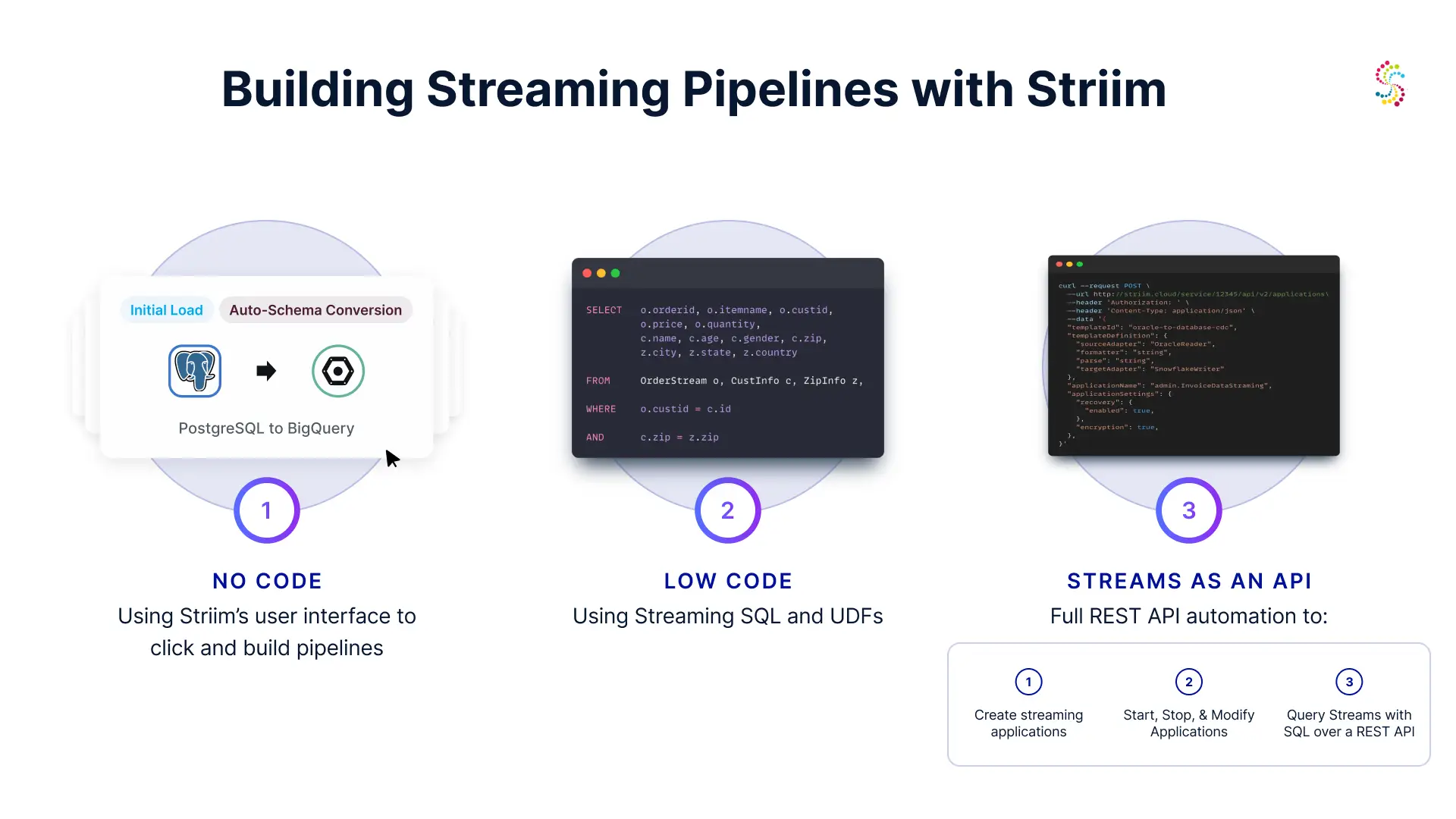
Striim pipelines streamline the process of data integration and real-time analytics. A pipeline starts with defining a source, which could be a database, log, or other data stream. Striim supports advanced recovery semantics such as A1P (At Least Once Processing) or E1P (Exactly Once Processing) to ensure data reliability.
See the full list of connectors Striim supports.
The data flows into an output stream, which can be configured to reside in-memory for low-latency operations or be Kafka-based for distributed processing. Continuous queries on these materialized streams allow real-time insights and actions. Windowing functions enable efficient data aggregation over specific timeframes. As the data is processed, it is materialized into downstream targets such as databases or data lakes. Striim ensures data accuracy by performing merges with updates and deletes, maintaining a true and consistent view of the data across all targets.
Here we’ll look at an application that reads data from Stripe, replicates data to BigQuery in real-time, then while the data is in flight, detects declined transactions and sends Slack alerts in real-time.
Striim’s Stripe Analytics Pipeline
Let’s dive into a practical example showcasing the power and simplicity of Striim’s streaming pipelines. The following is a Stripe analytics application that reads data from Stripe, processes it for fraudulent transactions, and generates alerts.
Application Setup
The first step is to create an application that manages the data streaming process. The StripeAnalytics application is designed to handle Stripe data, process fraudulent transactions, and generate alerts. This statement initializes the application with an automatic recovery interval of 5 seconds, ensuring resilience and reliability. The Recovery 5 second interval handles checkpointing for at least once or exactly once delivery from source to target with transactional support.
CREATE OR REPLACE APPLICATION StripeAnalytics RECOVERY 5 SECOND INTERVAL;
-- automatic recovery for A1P delivery to Slack alerts
Reading from Stripe
Next, we define the source to read data from Stripe. The StripeReaderSource reads data at 10-second intervals and outputs it to a stream called StripeStream. The ‘automated’ mode denotes that schemas will be propagated to downstream targets, an initial load of historical data will load, before starting the live CDC.
CREATE OR REPLACE SOURCE StripeReaderSource USING Global.StripeReader (interval:10s, mode:automated)
OUTPUT TO StripeStream PERSIST using ConfluentKafkaProperties;
-- Connect to Stripe API, pull all relevant objects on a 10 second refrequency
-- 'automated' mode for schema creation, initial load, and CDC
-- optionally, all streams can be persisted to your Kafka cluster for recovery
Striim streams are in-memory by default, but can be backed up to our managed Kafka or to your external Confluent Kafka cluster.
Writing to BigQuery
The processed data is then written to BigQuery for storage and analysis. The BigQueryWriter takes data from the StripeStream and loads it into BigQuery, automatically creating the necessary schemas.
CREATE OR REPLACE TARGET BigQueryWriter USING Global.BigQueryWriter ()
INPUT FROM StripeStream;
-- ELT all Stripe data into BigQuery, automatically creates schemas
Fraud Detection
To detect fraudulent transactions, we use a jumping window to keep the last two rows for each customer_id. This window is defined over a stream called FraudulentStream.
CREATE OR REPLACE JUMPING WINDOW FraudulentWindow OVER FraudulentStream
KEEP 2 ROWS PARTITION BY customer_id;
A continuous query (FetchFraudulentTransactions) is then created to pull declined transactions from the StripeStream and insert them into the FraudulentStream.
CREATE OR REPLACE CQ FetchFraudulentTransactions
INSERT INTO FraudulentStream
SELECT TO_STRING(GETDATA(e, "CUSTOMERID")) as customer_id,
TO_STRING(GETDATA(e, "FAILURECODE")) as failure_code
FROM StripeStream s
where META(s, "TableName").equals("Charges") and
GETDATA(s, "FAILURECODE") is not null and
TO_STRING(GETDATA(s, "FAILURECODE")).contains("card_declined");
Generating Alerts
To notify the relevant parties about fraudulent transactions, we generate alert events. The GenerateAlertEvents query groups the declined transactions by customer_id and inserts them into the FraudulentAlertStream.
CREATE OR REPLACE CQ GenerateAlertEvents
INSERT INTO FraudulentAlertStream
SELECT 'Declined Transaction by CustomerID ' + customer_id, customer_id + '_' + DNOW(), 'warning', 'raise',
' Declined transaction attempted by customer with ID : ' + customer_id
FROM FraudulentWindow
GROUP BY customer_id;
Sending Alerts to Slack
Finally, we create a subscription to send these alerts to a Slack channel. The FraudulentWebAlertSubscription uses the SlackAlertAdapter to deliver alerts to the specified channel.
CREATE OR REPLACE SUBSCRIPTION FraudulentWebAlertSubscription USING SlackAlertAdapter (
  channelName: 'john_936_21813_FraudulentWebAlertSubscription',
  isSubscription: 'true' )
INPUT FROM FraudulentAlertStream;
END APPLICATION StripeAnalytics;Benefits of Striim’s Declarative Approach
- Simplicity: SQL-based streaming pipelines make it easy to define rich processing logic.
- Scalability: Striim handles large volumes of data efficiently by scaling up and horizontally as a fully managed service, ensuring real-time processing and delivery.
- Flexibility: The ability to integrate with various data sources and targets provides unparalleled flexibility.
- Reliability: Built-in recovery mechanisms ensure data integrity and continuous operation.
- Consistency: Striim delivers consistent data across all targets, maintaining accuracy through precise merges, updates, and deletes.
- Portability: Striim can be deployed in our fully managed service, or run in your own cloud as a multi-node cluster containerized with Kubernetes.
Monitoring and Reliability
Are your reports stale? Is data missing or inconsistent? Striim allows you to drill down into pipeline metrics and provides out-of-the-box Slack alerts so your pipelines are always running on autopilot. Book a demo or start a free trial to see it in action.