
Salesforce has evolved. Beyond being seen as “just another CRM,” many enterprises use it as their central nervous system for customer interactions, sales pipelines, and service operations. But this critical data often remains locked within Salesforce, or worse, is only updated in downstream systems through slow, inefficient batch jobs. When your analytics platforms and operational applications are working with stale data, you’re a step behind.
That lag between insight and action is a significant obstacle to becoming a data-driven enterprise. That’s where Change Data Capture (CDC) in Salesforce comes in.
Salesforce CDC is a modern data integration feature designed to capture changes in Salesforce records—like a new lead, an updated opportunity, or an escalated case—and stream those changes to other systems in near real-time. Instead of polling for changes, CDC pushes the data the moment it happens. This capability is fundamental for keeping data synchronized across your entire technology stack, powering real-time analytics, and dramatically improving operational efficiency.
In this post, we’ll cover how Salesforce CDC works, how to get started, and why it’s a critical component for modern data integration, AI, and real-time customer engagement.
What’s Change Data Capture All About in Salesforce?
Within the Salesforce platform, Change Data Capture (CDC) is a publish/subscribe service that provides a real-time stream of data changes. Its primary purpose? To move beyond batch-based API polling, which is resource-intensive and slow, and enable a scalable, event-driven approach to data integration.
Instead of asking Salesforce “what’s new?” every five minutes, CDC actively notifies downstream systems the instant a record is created, updated, deleted, or undeleted. This allows enterprises to track changes to any Salesforce object—standard or custom—and propagate those changes immediately.
For any business running on real-time intelligence, this capability is essential. It ensures you have data consistency across disconnected platforms, like synchronizing customer support cases from Salesforce with an operational dashboard, or updating an enterprise data warehouse like Snowflake or Azure Synapse the moment a sales opportunity is closed.
Key Parts and Features of CDC Within Salesforce
Salesforce CDC is built on a few core components that enable its event-driven architecture:
- Change Events: These are your core data payloads. A change event is a JSON message that describes a specific change to a Salesforce record, including which fields were modified and their new values.
- Event Channels: Change events are published on specific channels. You can subscribe to a channel for a single Salesforce object (e.g., AccountChangeEvent) or use the ChangeEvents channel to receive merged events from multiple objects.
- Merged Change Events: To simplify processing, Salesforce can combine multiple change events that occur within the same transaction into a single, consolidated event. This reduces redundancy and streamlines the data for subscribers.
- Schema Versioning: Salesforce includes a schema ID in every event. If your Salesforce object’s schema changes (e.g., a new custom field is added), the schema ID is updated. This allows downstream consumers to detect schema drift and handle changes without breaking the integration pipeline.
How Does Change Data Capture Work in Salesforce?
At a high level, Salesforce CDC operates by publishing change events to an event bus whenever data in a Salesforce object changes. This process is asynchronous and designed for high volume and low latency. Once a change is committed to the Salesforce database, the platform generates a corresponding change event and makes it available to subscribers.
This mechanism fundamentally shifts the integration paradigm from “pull” (batch polling) to “push” (real-time streaming), forming the foundation for a responsive, event-driven architecture.
How Events are Made and Subscribed To
When you enable CDC for a specific Salesforce object (like Account or a custom object Invoice__c), Salesforce begins monitoring that object for changes. When a user or an automated process creates, updates, deletes, or undeletes a record, Salesforce generates a detailed JSON payload. This event includes header fields (like the transaction ID and timestamp) and data fields (containing the changed values).
Subscribers (like an external application or an integration platform) can then connect to Salesforce’s Streaming API to listen for these events. This API uses a long-polling mechanism (CometD) to achieve sub-second latency, ensuring subscribers receive notifications almost instantly.
But the raw event stream is just the first step. To make this data truly useful, it often needs transformation, filtering, or enrichment in motion. That’s where platforms like Striim add critical value. Striim can subscribe to the CDC event stream and apply real-time, SQL-based transformations. This lets you cleanse data, mask sensitive PII, or join the Salesforce data with other streams—before it even lands in the target system. This in-stream analytic capability ensures that businesses are acting on clean, fully contextualized data instantly.
How Data Flows and Stays in Sync
Once an event is published, it flows from the Salesforce event bus to all active subscribers. These subscribers consume the events and use the data to perform synchronization tasks. For example, a change to a customer record in Salesforce can trigger an immediate update in an external billing system, a marketing automation platform, and a data warehouse simultaneously.
This real-time flow is critical for operational use cases. A common example? Updating a customer’s service status. When a support case is escalated in Salesforce, a CDC event can instantly update a central analytics dashboard, providing leadership with a live view of service-level agreement (SLA) compliance. Similarly, logistics companies like UPS have used CDC to stream data for fraud detection, catching anomalies as they happen rather than hours later.
But to be effective, this data flow must be reliable and the data itself must be ready for use. Striim’s real-time data transformation capabilities are essential here, ensuring that the data arriving at its destination is not just fast, but also clean, correctly formatted, and ready for immediate insight generation. Striim also provides in-built recovery with an extensive library of connectors, guaranteeing that data stays in sync across all systems and repositories.
How to Get Started with Change Data Capture in Salesforce
Activating Salesforce CDC is straightforward. But building resilient, enterprise-grade pipelines from it requires careful planning. Here’s how to approach it.
Setting Things Up
Enabling CDC within Salesforce is a simple administrative task. You can select which standard and custom objects you want to publish change events for directly in the Salesforce Setup UI.
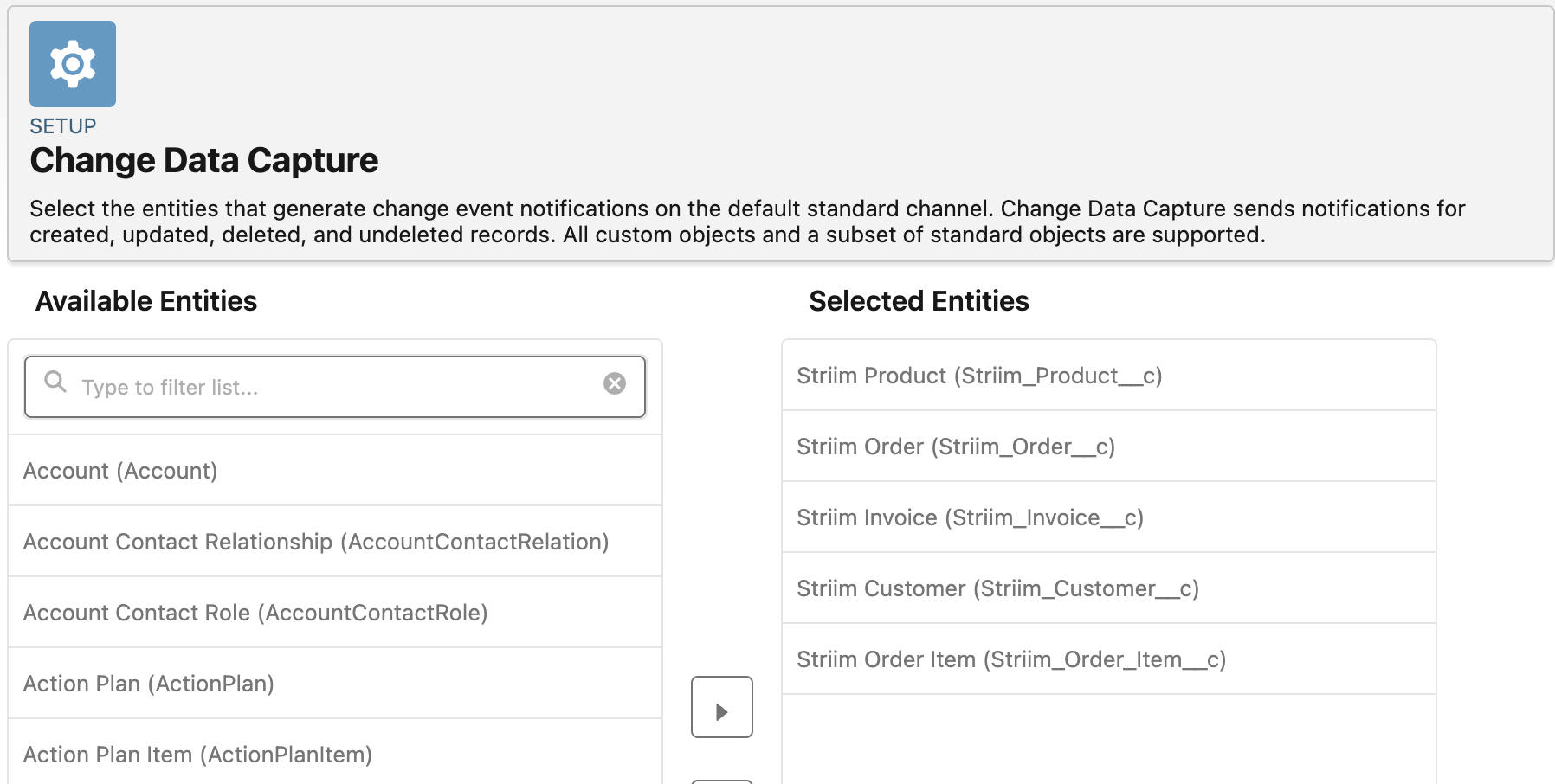
The real work begins with managing the event stream. Best practices for managing subscriptions include:
- Deciding what to consume: Subscribing to every change event from every object can create a lot of noise. Identify the critical objects and data points your business needs in real time.
- Implementing a durable subscriber: Your subscribing application must be able to handle event replays in case of a connection failure to avoid data loss.
- Handling schema changes: Your integration logic needs to parse event schema versions to prevent downstream failures when a Salesforce object is modified.
This is exactly where a dedicated streaming platform comes into its own. For instance, Striim offers a low-code/no-code UI that radically simplifies this process. Data teams can visually map custom Salesforce objects and fields to their target destinations, drastically cutting engineering dependency and accelerating the time-to-value for new integration pipelines.
Connecting with Other Systems
Once CDC is enabled, you need to connect the event stream to your other systems. This is typically done by building a client that subscribes to the Streaming API or by using a pre-built connector from an integration platform.
The opportunities here are huge:
- Real-Time Analytics: Stream Salesforce opportunity changes directly into an analytics platform like Google BigQuery or Snowflake. This allows sales leadership to access live pipeline dashboards instead of waiting for nightly reports.
- Operational Sync: Send updated case data to an external support-ticketing system, ensuring agents in both systems see the same information.
- Marketing Automation: Trigger immediate, personalized emails from a marketing platform when a lead’s status is updated in Salesforce.
Platforms like Striim provide out-of-the-box, high-performance connectors for these exact scenarios. This pre-built connectivity to sources like Salesforce CDC and destinations like Google BigQuery, Snowflake, or Kafka, eliminates complex custom API development and ensures reliable, low-latency data delivery.
Why Salesforce Change Data Capture Is a Big Deal for Enterprise Data Integration
Salesforce CDC is more than just a data synchronization feature. It’s your ticket to making Salesforce the beating heart of your data operations, rather than a passive repository you only query periodically.
Keep Salesforce Data Synced Across All Your Systems
The most immediate benefit? Data consistency. Any change in Salesforce—a lead status update, an escalated support case, or a modified contract—is immediately flagged and reflected in downstream systems. This eliminates the data integrity problems and stale reports that plague batch-based integrations. For example, you can update customer records in Google BigQuery the instant they change in Salesforce, or trigger personalized email workflows the moment an opportunity is marked “Closed-Won.” Striim makes this seamless, providing out-of-the-box connectors and low-latency data pipelines to guarantee your data is synchronized across CRMs, analytics platforms, and data warehouses.
Power Real-Time Customer Engagement
When response time is your competitive advantage, CDC lets you use Salesforce changes to drive responsive customer experiences. When a high-value customer files a support ticket, that CDC event can be streamed instantly to provide context to a support agent’s dashboard. A change in a customer’s loyalty tier can trigger an immediate points adjustment. Streaming Salesforce CDC data with Striim to engagement platforms like ServiceNow ensures your targeting and timing are based on the absolute freshest data, not last night’s batch upload.
Simplify Integration Complexity and Maintenance
Let’s face it: the traditional method of API polling is brittle and resource-intensive. It creates a heavy load on Salesforce APIs and requires complex custom logic to manage state, check for duplicates, and handle API limits. Salesforce CDC eliminates this entirely. By pushing changes, it dramatically reduces reliance on complex middleware and batch windows. Striim further-minimizes this operational burden through its no-code UI for mapping custom Salesforce objects and with resilient streaming infrastructure that manages data delivery without requiring constant manual oversight.
Get Analytics-Ready Data Without the Lag
Your teams need to make decisions on what’s happening now, not what happened yesterday. Salesforce CDC allows change events to be enriched, transformed, and delivered to analytics platforms like Snowflake or Databricks in near real time. This means a sales leader can see an accurate pipeline forecast at any moment, or a data science team can feed a churn model with customer interactions as they happen. Striim’s ability to perform in-flight data transformations ensures this data isn’t just fast—it’s already cleansed, formatted, and joined with other relevant data, making it analytics-ready on arrival.
Enable Scalable, Event-Driven Architectures
Ultimately, Salesforce CDC transforms Salesforce from a simple application into a true event source for a modern data architecture. These real-time events can be used to trigger downstream automation workflows, sync operational systems, or feed machine learning pipelines. This event-driven model is far more scalable and responsive than legacy point-to-point integrations. Striim is built for these mission-critical use cases, offering a platform that can operate in hybrid-cloud or multi-cloud environments, with active-active failover and built-in security to ensure the data stream is always on and always secure.
How Salesforce Change Data Capture Feeds AI and Machine Learning Use Cases
Artificial intelligence and machine learning models are only as good as their data—and they’re only as effective as the freshness of the data they use for inference. Batch data means your AI is always acting on the past. Salesforce CDC provides the real-time stream you need to make AI predictive and responsive.
Improve Customer Churn Prediction Models
Instead of running a churn model once a week on a static data export, you can stream real-time changes to key predictive fields. When a customer’s support interactions spike, their opportunity status changes, or their account activity drops, a CDC event can feed this data directly into a churn prediction model. This lets you get an immediate, updated churn score and proactively engage at-risk customers with retention offers before it’s too late. Striim’s ability to filter, enrich, and route these specific CDC events to ML pipelines with minimal latency is critical to making this proactive model a reality.
Power Real-Time Lead Scoring and Routing
Not all leads are created equal, and their quality can change in an instant. A lead who suddenly changes their job title or rapidly increases their engagement with your content should be prioritized. You can use Salesforce CDC to trigger AI-based lead scoring models the moment these updates occur. The model’s output—a new, higher score—can then trigger an automated routing rule to send that lead to the correct sales team. This intelligent routing, powered by Striim streaming these enriched events to downstream workflows, dramatically reduces sales response times and focuses efforts on the hottest leads.
Detect Anomalies and Trigger Smart Alerts
For complex operations, identifying unusual behavior is key to managing risk. You can feed CDC-driven data into anomaly detection models to flag behaviors that fall outside the norm. This could include a sales deal suddenly changing in value by a large amount, an unusual spike in support cases from one account, or a change to a user’s permissions. These events can trigger intelligent alerts or automated mitigation steps, such as locking an account or flagging a deal for review. Striim supports these workflows by providing the high-throughput, low-latency event filtering and real-time delivery required to power sensitive alerting systems and operational dashboards.
The Evolution of Change Data Capture Technologies
Change Data Capture as a concept isn’t new. It was born from the need to solve the fundamental inefficiencies of batch processing. The evolution from nightly batch jobs to real-time streaming is central to the story of modern data integration.
How It All Started
In the past, the most common way to get data out of a database was a bulk export: a “batch job” that typically ran overnight. This approach was slow, resource-intensive, and meant that by the time data arrived at its destination, it was already hours or even days old. Industries like finance and retail, needing to detect fraud or manage inventory, quickly found this latency unacceptable.
Early forms of CDC were developed to address this, often using triggers on the database tables or complex query-based methods. While an improvement, these approaches could place a heavy performance burden on the source systems and were often brittle and difficult to maintain.
What’s New and Trending
The biggest innovation in modern CDC is the move to non-intrusive, log-based CDC. That’s the approach used by industry-leading platforms like Striim. Instead of querying the database or adding triggers, log-based CDC reads changes directly from the database’s transaction log (like the redo log in Oracle). This method has almost no impact on the source system, captures every single change with sub-second latency, and is far more resilient.
Today, the trend is to combine this powerful, low-latency CDC with real-time transformation, analytics, and AI. Modern CDC is no longer just about moving data; it’s about making that data instantly useful. This means filtering, enriching, and formatting the data in-stream so it arrives at its destination—whether that’s a data warehouse, a Kafka topic, or an AI model—as an analytics-ready, actionable event.
Tackling the Challenges of Salesforce Change Data Capture at Scale
Salesforce CDC is powerful, but streaming mission-critical data in real time isn’t without its challenges. For large enterprises with heavily customized Salesforce instances, high data volumes, and strict SLAs, addressing these challenges is a must.
Staying Secure and Compliant in a Streaming World
Salesforce data is sensitive. It’s often full of Personally Identifiable Information (PII), financial records, and private customer communications. Streaming this data demands a robust security posture, especially across hybrid and multi-cloud environments. If you’re in a regulated industry like healthcare, finance, or retail, you also have to meet strict compliance mandates. Striim is engineered for this, offering in-flight data masking and encryption, role-based access control, and enterprise-grade security certifications, including SOC 2, HIPAA, and GDPR readiness.
Navigating API Limits and Event Throttling
Salesforce, like any SaaS platform, enforces event delivery limits and API caps to ensure platform stability. In high-change environments, such as during a major data import or a peak sales period—it’s possible for an organization to exceed these limits. This can lead to event throttling or, worse, data loss if your subscriber can’t keep up. Striim helps you manage this risk with intelligent, buffer-based delivery, built-in rate-limiting controls, and automated retry mechanisms to ensure data is never lost, even if the pipeline experiences backpressure.
Ensuring Pipeline Reliability and Data Quality
When a real-time stream feeds your analytics or an operational application, data integrity is non-negotiable. Risks like event delivery failure, duplicate messages, or out-of-order processing can corrupt downstream systems and erode trust in the data. That’s why “at-least-once” delivery just isn’t good enough for enterprise use cases. Striim provides exactly-once processing (E1P) semantics to guarantee data accuracy, along with built-in monitoring, error handling, and real-time alerting to safeguard your mission-critical data pipelines.
Scaling Across a Fragmented Data Stack
Salesforce is rarely your only system of record. The real challenge is integrating Salesforce CDC with a diverse and fragmented landscape of other databases, data lakes, BI tools, and applications. Your teams often struggle to build and maintain dozens of siloed, point-to-point pipelines, creating a new form of integration sprawl. Striim solves this with a unified platform and a broad library of pre-built connectors. This lets your teams manage all their real-time data pipelines—from Salesforce and other sources—in one place, reducing engineering burden and ensuring consistency across the entire data stack.
Real-World Wins with Salesforce Change Data Capture
Enterprises across industries are pairing Salesforce CDC with real-time streaming platforms like Striim to modernize how they integrate, analyze, and act on customer data. The tangible value comes from streaming these changes into downstream systems, transforming Salesforce from a static repository into a dynamic, real-time event source.
Use Cases That Drive Real Results
- Retail & E-commerce: Real-time synchronization of product catalog or loyalty program changes from Salesforce to customer-facing web and mobile applications. This ensures customers always see the most accurate pricing and rewards, enabling truly personalized, in-the-moment experiences.
- B2B SaaS: Streaming opportunity and account updates from Salesforce to analytics platforms like Snowflake or Google BigQuery. This gives sales and finance leaders an up-to-the-second view of the sales pipeline, enabling more accurate forecasting and real-time performance tracking.
- Financial Services & Healthcare: Routing Salesforce case data or patient record updates to operational dashboards and case-management systems. This accelerates service-level response times, improves compliance monitoring, and ensures all agents have the most current information.
Salesforce CDC in Action
Leading organizations are moving beyond simply syncing data. They are using Striim to capture Salesforce CDC events and transform them in-flight, enriching them with data from other operational systems. This enriched data then feeds everything from real-time customer 360 dashboards to fraud detection engines, turning simple Salesforce updates into powerful, contextualized business insights.
Unlocking the Potential of Change Data Capture with Striim
Salesforce Change Data Capture is a foundational technology for any enterprise that wants to act on customer data the moment it’s born. It’s the engine for ending data latency, enabling real-time analytics, and powering responsive AI.
But activating CDC is just the first step. Unlocking its true potential requires an enterprise-grade streaming platform that can reliably handle the operational challenges of security, scale, and schema evolution.
Striim is the unified platform for enterprise-grade CDC. Our solution is engineered to amplify the value of Salesforce CDC, providing a low-code/no-code interface for building mission-critical data pipelines. With Striim, you can go beyond simple synchronization and use real-time transformations to cleanse, enrich, and shape your Salesforce data in-flight—delivering analytics-ready insights to any target, with sub-second latency.
If you’re ready to move beyond batch processing and turn your Salesforce data into a real-time competitive advantage, we can help.
Explore Striim’s Salesforce integration and book a demo to see how you can build enterprise-grade, real-time data pipelines in minutes.
