Reporting Hierarchy
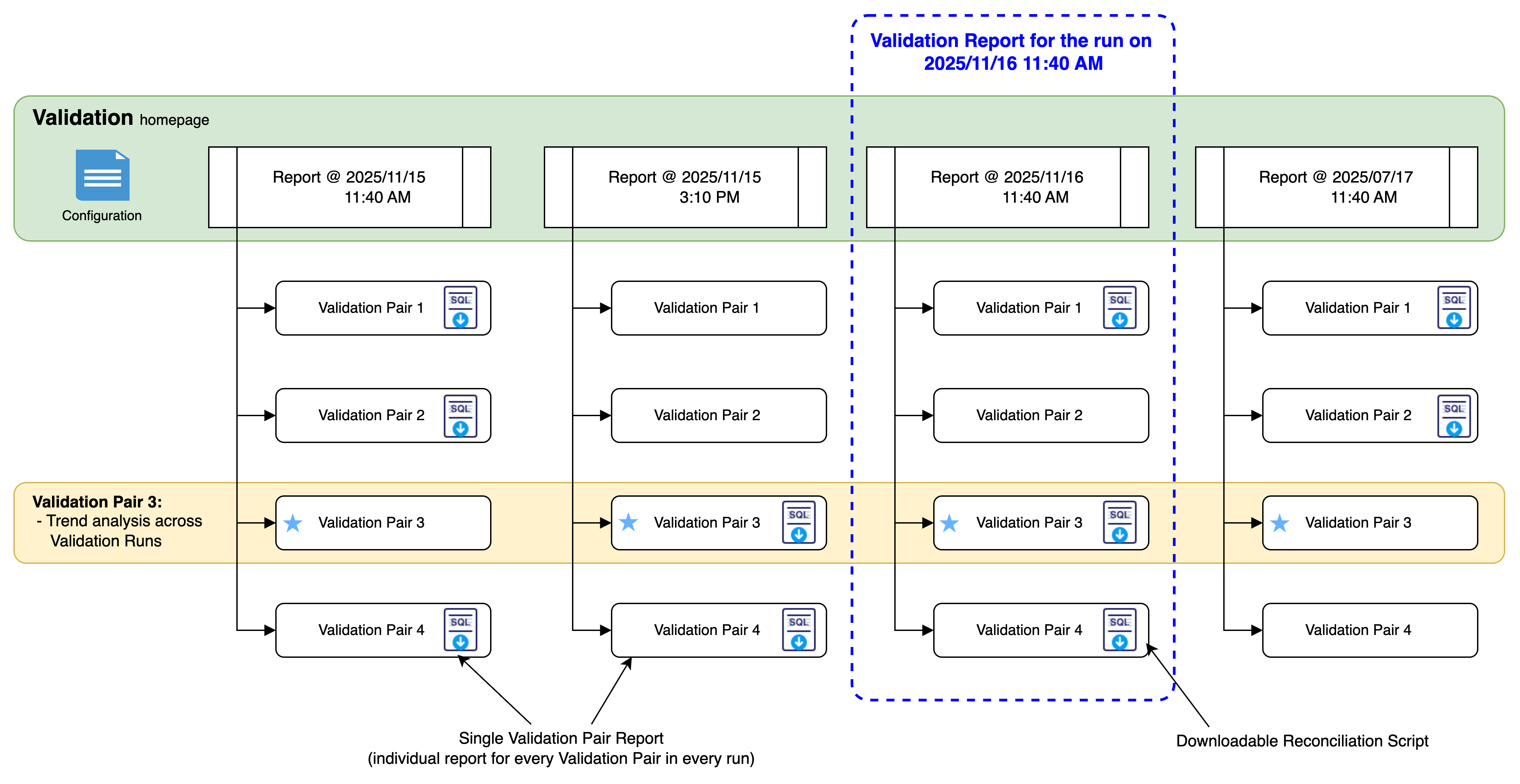
Validata organizes its reporting framework into a layered, time-stamped hierarchy that mirrors how validations are configured, executed, and analyzed. Each layer provides progressively deeper visibility—from high-level run outcomes to row-level discrepancy details—and increasingly actionable insight into data consistency.
Validation
At the top of the hierarchy is the Validation homepage, which presents both the Validation Configuration and the complete history of Validation Reports generated across all runs.
The configuration defines the Source and Target systems, the validation scope and method, and the set of Validation Pairs included in the comparison (see Configuring a validation for more information).
The Validation homepage provides a consolidated, high-level view of activity across all runs of the Validation. Use this view to monitor long-term consistency, observing trends like how the number of Out-of-Sync Validation Pairs or records has evolved over time
Validation Report
A Validation Report is produced at the end of every Validation Run. Validata generates a distinct report for each run, regardless of outcome. Each report identifies which Validation Pairs finished In-Sync and which finished Out-of-Sync.
If you selected tables using wildcard rules, the Validation Report also identifies which Validation Pairs were included—and which were excluded—in that particular run, giving you a clear sense of comparison coverage for the dataset on that run.
Validation Pair Report
At the deepest level of the hierarchy is the Validation Pair Report, the foundational reporting unit in Validata.
During each run, Validata compares the mapped Source and Target tables for every Validation Pair defined in the configuration and generates a dedicated report for each pair. These reports surface all Out-of-Sync records and, where applicable, provide the SQL-based reconciliation script required to align the Target with the Source.
For Out-of-Sync pairs, the report shows exactly which records differ, where they differ, and why.
Each Validation Pair Report also includes a historical trend for that specific pair. By observing how in-sync and out-of-sync rates—and Source and Target record counts—change over time, you gain actionable insight into replication consistency and can detect emerging drift before it affects downstream systems.
In addition, you can download the Validation Pair Report in JSON format, enabling you to integrate the comparison results into your preferred external tools or workflows.