Introducing Striim for ClickHouse
This topic introduces Striim for ClickHouse, a fully managed SaaS streaming service that continuously captures and delivers real-time changes from operational databases, SaaS applications, and file systems into ClickHouse.
For a summary of features and capabilities, see Product summary.
To create your first application that writes to ClickHouse, see Build your first application.
To start your 14-day free trial of Striim for ClickHouse, see Subscribe and sign up.
What is Striim for ClickHouse?
Striim for ClickHouse is a fully managed streaming data integration and analytics service, hosted on Striim Cloud. It delivers change data capture (CDC) and non-CDC data to ClickHouse and File Writer targets. It is available as a self-service, monthly usage-based SaaS with no annual commitment.
Instead of relying on scheduled batch ETL jobs to refresh ClickHouse, Striim continuously streams inserts, updates, and deletes from source systems as they occur, helping keep ClickHouse synchronized with current operational data. Striim for ClickHouse supports use cases such as real-time analytics, observability, data warehousing, AI, and machine learning.
You can sign up directly through Striim with credit-card billing or through AWS Marketplace. A 14-day free trial is available. Choose the Standard or Premium plan based on the sources and capabilities you need.
Overview
A Striim for ClickHouse service sits between your source systems and ClickHouse, continuously capturing and streaming data rather than moving it in scheduled batches. The service has three parts.
Sources: non-CDC sources, and CDC readers for supported operational databases, data warehouses, and SaaS applications. Standard and Premium plans differ in the sources available with each; see Product summary for details.
Streaming service: A dedicated Striim Cloud service on AWS processes and optionally transforms events in flight. Compute infrastructure capacity depends on the selected plan.
Targets: ClickHouse and File Writer are the only supported targets for this offering.
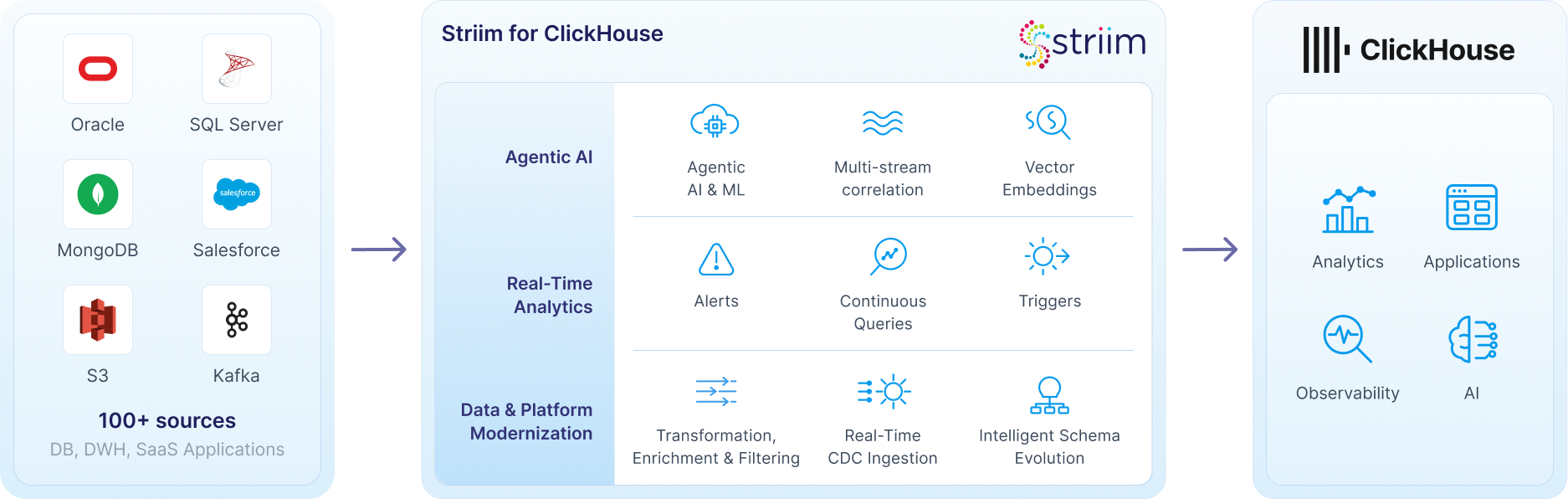
Striim capabilities such as pipeline monitoring, in-flight transformations, schema handling, and AWS PrivateLink for private connectivity are also available. See the following sections for details.
Use cases
ClickHouse is widely used for real-time analytics, observability, data warehousing, and increasingly for AI and machine learning workloads, categories where the value of the data depends on how current it is. Striim's role across all of these is the same: capturing changes from source systems the moment they happen and streaming them into ClickHouse rather than waiting on scheduled batch loads.
Retrieval-augmented generation (RAG) and AI agents
ClickHouse's native vector search and MCP server let AI agents query operational data directly. Striim keeps those tables current through CDC, so an agent answering questions about stock, orders, or account status reads data that is seconds old rather than a nightly snapshot, which avoids confident answers built on stale context.
Feature stores and real-time model inference
ClickHouse can serve as a simplified, central feature store using its aggregation and vector capabilities. Striim's CDC keeps entity-level features current for models that score in near real time, such as fraud detection or personalization, rather than waiting on a batch refresh.
Real-time analytics
ClickHouse powers interactive dashboards and applications that aggregate large volumes of data on the fly and return results in milliseconds. Striim's CDC readers keep the underlying ClickHouse tables current by streaming inserts, updates, and deletes from a wide range of operational databases as they occur, so dashboards reflect activity from seconds ago rather than the last batch cycle.
Observability
ClickHouse is used at scale as a SQL-based store for logs, metrics, and traces, supporting anomaly detection and infrastructure monitoring. ClickStack, ClickHouse's own observability stack, ingests telemetry through OpenTelemetry. Striim complements this by streaming a different, equally important signal into the same ClickHouse instance: real-time changes from operational databases and applications.
Because both signals land in the same ClickHouse tables, teams can query telemetry and database change data together, for example to check whether a spike in application errors lines up with a batch of failed database writes, or whether latency degraded right after a schema change, without exporting data to separate tools to line up the timelines by hand.
Data warehousing
ClickHouse is used for reporting, internal applications, and analytical workloads that require fast access to large volumes of data. Striim provides a direct path from enterprise sources such as Oracle, SQL Server, Snowflake, and Salesforce into ClickHouse. This lets teams continuously move data into ClickHouse without building and maintaining an intermediary staging or streaming layer.
E-commerce, retail, and other event-driven industries
Real-time inventory, order, and customer activity data streamed continuously into ClickHouse supports use cases such as live inventory tracking, fraud and anomaly detection, and customer 360 views, where the usefulness of the insight depends on how current the underlying data is. ClickHouse's retail-focused ingestion patterns typically assume an event stream such as Kafka, Kinesis, or Pub/Sub is already in place. Striim for ClickHouse provides another route in: capturing order and inventory changes directly from the underlying OLTP database through CDC, which is useful for teams that do not already have an event-streaming layer built out.